In this page
CSV Analysis feature of GreyCat
This feature of GreyCat is a very fast and powerful type deduction feature, which allows the user to explore millions of CSV file lines in a matter of seconds.
It allows you to explore:
8,000,000 lines of Csv (1.3 GB, 15 columns) in 4.8s,
Average speed of: 1.7M rows/second (277 MB/s.) with unlimited date check limits.
Analysis
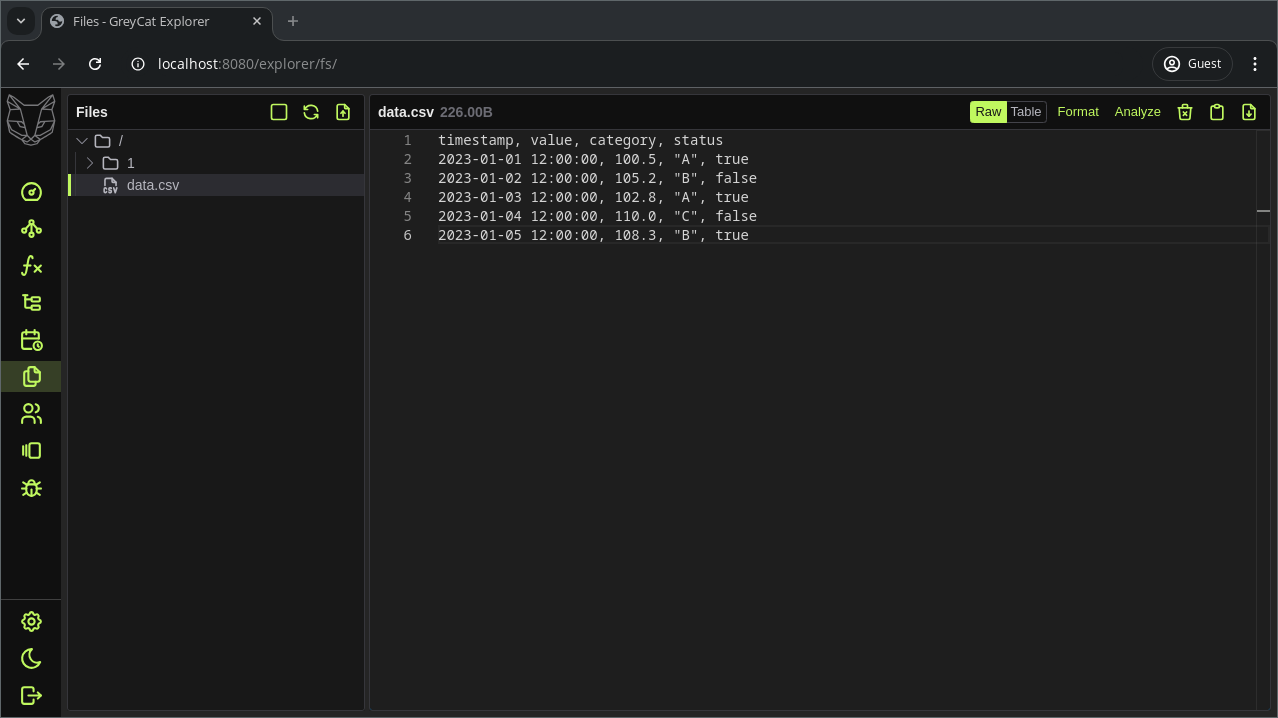
Dataset
timestamp,value,category,status
2023-01-01 12:00:00,100.5,"A",true
2023-01-02 12:00:00,105.2,"B",false
2023-01-03 12:00:00,102.8,"A",true
2023-01-04 12:00:00,110.0,"C",false
2023-01-05 12:00:00,108.3,"B",true
Code
var paths = Array<String> { "input.csv" };
var config = CsvAnalysisConfig { separator: ',' };
var csv_stats = Csv::analyze(paths, config);
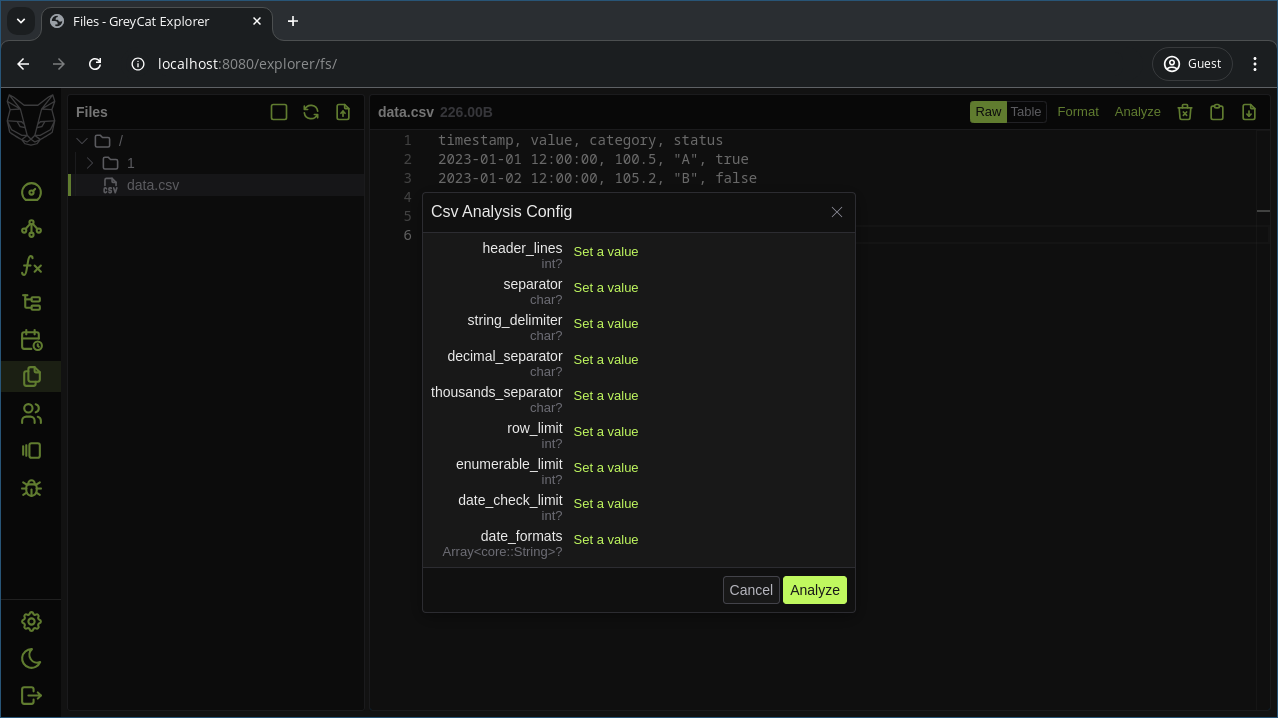
Csv::analyze takes the paths of the files to analyze, relative to the working directory of the process, and an optional CsvAnalysisConfig. Like Csv::generate and Csv::sample, it requires the admin permission when called over HTTP or MCP.
Result
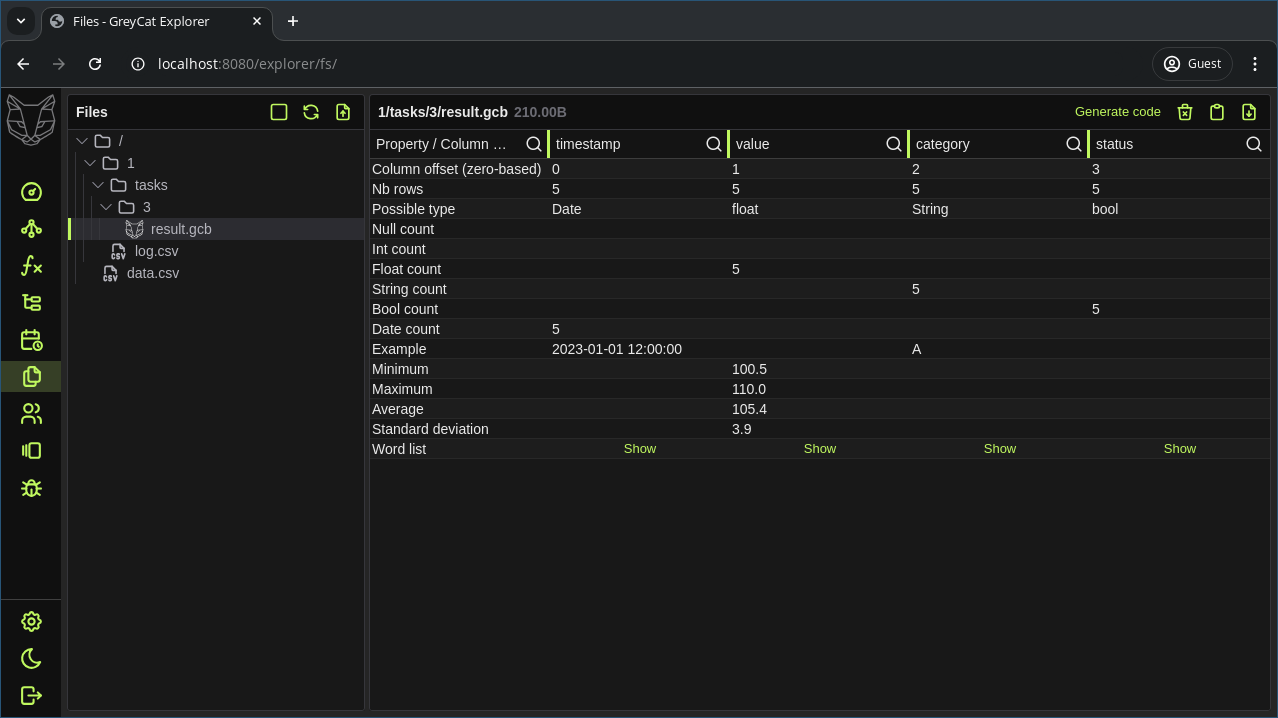
Analyzing the above CSV would yield:
CsvStatistics {
  header_lines: 1,
  separator: ',',
  string_delimiter: null,
  decimal_separator: null,
  thousands_separator: null,
  columns: Array<CsvColumnStatistics> { /*...*/ },
  line_count: 5,
  fail_count: 0,
  file_count: 1
}
Analysis: column 0
CsvColumnStatistics {
  name: "timestamp",
  example: "2023-01-01 12:00:00",
  null_count: 0,
  bool_count: 0,
  int_count: 0,
  float_count: 0,
  string_count: 0,
  date_count: 5,
  date_format_count: Map<String,int> {
    "%Y-%m-%d %H:%M:%S": 5
  },
  enumerable_count: Map<any,int> {},
  profile: Gaussian {
    sum: null,
    sumsq: null,
    count: null,
    min: null,
    max: null
  }
}
Analysis: column 1
CsvColumnStatistics {
  name: "value",
  example: 100.5,
  null_count: 0,
  bool_count: 0,
  int_count: 0,
  float_count: 5,
  string_count: 0,
  date_count: 0,
  date_format_count: Map<String,int> {},
  enumerable_count: Map<any,int> {},
  profile: Gaussian {
    sum: 526.8,
    sumsq: 55564.02,
    count: 5,
    min: 100.5,
    max: 110.0
  }
}
Analysis: column 2
CsvColumnStatistics {
  name: "category",
  example: "A",
  null_count: 0,
  bool_count: 0,
  int_count: 0,
  float_count: 0,
  string_count: 5,
  date_count: 0,
  date_format_count: Map<String,int> {},
  enumerable_count: Map<any,int> {
    "B": 2,
    "C": 1,
    "A": 2
  },
  profile: Gaussian {
    sum: null,
    sumsq: null,
    count: null,
    min: null,
    max: null
  }
}
Analysis: column 3
CsvColumnStatistics {
  name: "status",
  example: true,
  null_count: 0,
  bool_count: 5,
  int_count: 0,
  float_count: 0,
  string_count: 0,
  date_count: 0,
  date_format_count: Map<String,int> {},
  enumerable_count: Map<any,int> {},
  profile: Gaussian {
    sum: null,
    sumsq: null,
    count: null,
    min: null,
    max: null
  }
}
Code generation
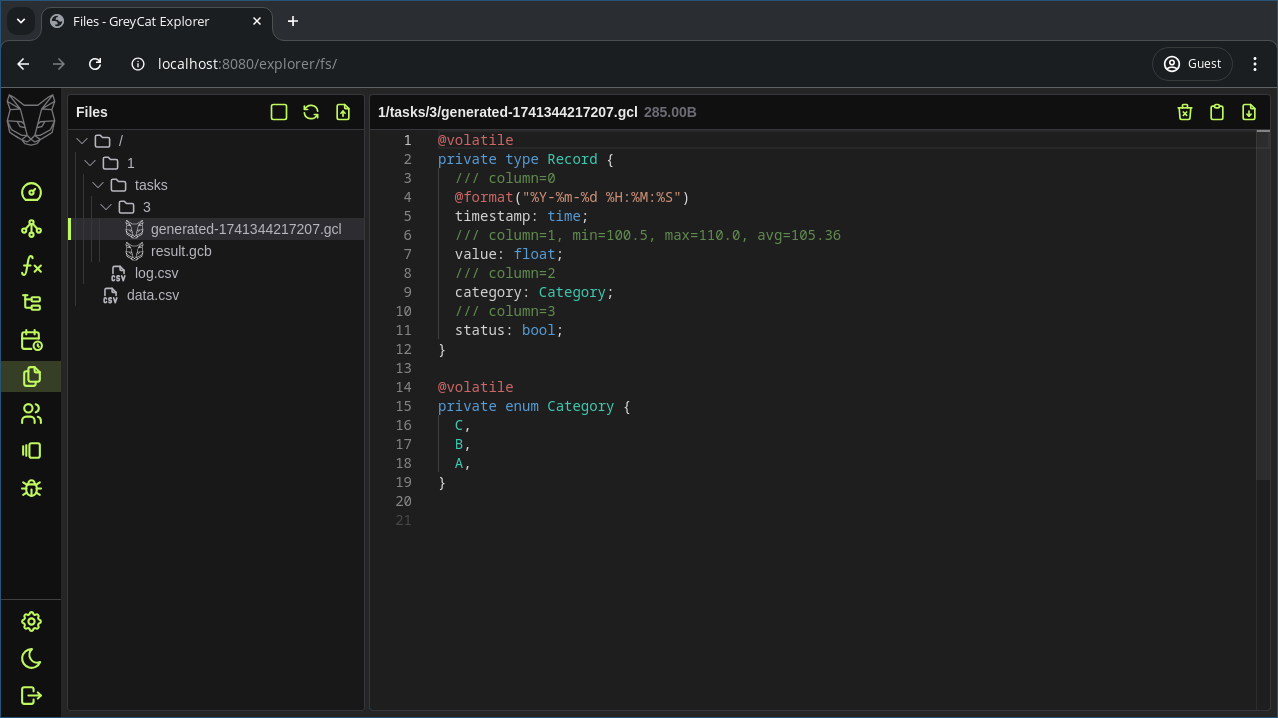
From the CsvStatistics we can generate the GCL types/enums for the reader:
var code = Csv::generate(csv_stats);
println(code);
@volatile
private type Record {
  /// column=0
  @format("%Y-%m-%d %H:%M:%S")
  timestamp: time;
  /// column=1, min=100.5, max=110.0, avg=105.36
  value: float;
  /// column=2
  category: Category;
  /// column=3
  status: bool;
}

@volatile
private enum Category {
  B,
  C,
  A,
}
This feature is available in the explorer to ease the import of multiple complex datasets